
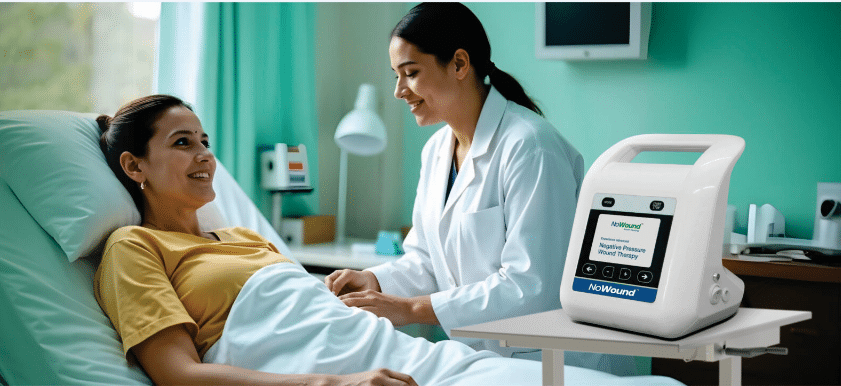
Pressure ulcers, also known as pressure injuries or bedsores, are chronic wounds that develop in individuals with limited mobility, such as bedridden or wheelchair-using patients, critically ill patients, or post-surgical patients. If left untreated, pressure ulcers can lead to serious complications.
Negative Pressure Wound Therapy (NPWT) is a noninvasive wound care technique that improves healing and reduces complications by maintaining an optimal wound environment and supporting tissue integrity and oxygenation. It involves applying a specialized dressing connected to a vacuum pump, continuously or intermittently applying controlled suction to the wound site.
Pressure ulcers form when sustained pressure restricts blood flow to specific areas, leading to tissue breakdown, necrosis, and potential infections. The most affected areas are the sacrum, heels, elbows, and hips.
Factors that increase susceptibility to pressure ulcers include:
Risk Factor | Impact on Skin |
Prolonged immobility | Sustained pressure on the lower back, heels, and elbows, causing skin damage |
Poor circulation | Low oxygen supply to tissues and delayed healing |
Excess moisture | Makes skin soft and weak |
Shear and friction | Increases risk of skin tearing and irritation |
Reduced sensory function | Prevents detection of early skin damage |
NPWT works by:
Effective Group | Risk Factors | NPWT Benefit |
Stage III and IV pressure ulcers | Deep wounds with significant tissue loss. | Facilitates tissue regeneration and wound closure |
Non-healing chronic wounds | Ulcers that haven’t improved with standard treatments. | Creates an optimal healing environment |
Heavily exudative wounds | Wounds producing excessive drainage. | Removes exudate and reduces infection risk |
Surgical wounds resulting from ulcer debridement | Postoperative wounds requiring advanced healing support. | Supports faster recovery after surgical procedures |
NPWT provides continuous protection, reducing the need for frequent manual interventions.
Factor | Traditional Methods | NPWT |
Moisture control | Barrier creams, absorbent pads | Actively removes excess fluid |
Pressure relief | Repositioning, support surfaces | Distributes pressure with dressing |
Perfusion support | Massage, manual interventions | Enhances circulation with micro deformation |
Edema reduction | Compression therapy | Continuous suction reduces swelling |
NPWT is most effective for Stage III and IV pressure ulcers but may not be suitable for shallow wounds.
Some patients may experience mild discomfort, but it reduces pain by stabilizing the wound environment.
The duration depends on each patient’s risk factors and clinical evaluation. Typically, NPWT is applied continuously with regular assessments (every 2-3 days) to ensure optimal protection and to adjust treatment as needed.
Some patients may experience mild discomfort from the negative pressure. However, proper application, careful adjustment of pressure settings (commonly between -80 to -125 mmHg), and the option for intermittent suction can help mitigate any discomfort.
NPWT devices are available for home use under medical supervision, enhancing patient mobility and comfort.
NPWT is generally safe. However, potential risks include minor bleeding, skin irritation, and device-related discomfort. Proper monitoring minimizes complications.
Dressings are typically changed every 2-3 days to maintain an effective seal and optimal protection. The schedule may be adjusted based on skin condition, moisture levels, and overall wound status.
Our NPWT dressings are waterproof, so patients can quickly shower or wash. However, they must ensure the dressing remains appropriately sealed and not overly saturated during these activities.
Costs depend on the device type, treatment duration, and the treating physician. While initially expensive, NPWT reduces overall costs by reducing hospital stays and decreasing complications.
NPWT may be an effective treatment option for pressure ulcers. It reduces pressure, controls moisture, and enhances tissue perfusion to accelerate healing, reduce infection risk, and improve outcomes. Consult your doctor to determine if NPWT suits your wound care needs.